Welcome to my project: Building our SFS Family Tree!
The Family Tree has its own website now! Check it out!!
For an introduction to the project, and to PARTICIPATE, follow this link.
Building our freshwater academic family tree
I'm working on a project to connect the members of the Society for Freshwater Science via their academic relationships, namely connections to advisors and institutions, as a proxy for influence on their scientific development. If you want to PARTICIPATE, click here.
Project: Impact of Harvesting and Wildfires on Forested Drinking Water Source Catchments
Use of Parsimonious Models to estimate impact of Forest Harvesting and Wildfires on Forested Drinking Water Source Catchments across Canada
Link to Nandita Basu Research Page
Link to forWater Website
I will be joining a group of researchers from across Canada researching the impacts of disturbances such as wildfires on drinking water treatability in areas relying on forested source catchments. I will be exploring how the use of parsimonious models can aid in predicting sediment and carbon export from these catchments, and help researchers and experts from these catchments understand possible processes leading to this export at a broad scale.
Link to Nandita Basu Research Page
Link to forWater Website
![]() |
| forWater network, funded by NSERC |
![]() |
| This research is supported by the Vanier Canada Graduate Scholarship |
Find me at AGU!
H23D-1703: Investigating the Role of Hydrologic Residence Time in Nitrogen Transformations at the Sediment-Water Interface using Controlled Variable Head Experiments
Tuesday, 12 December 2017; 13:40 - 18:00 Poster Hall D-F
2017 Fall Meeting of the American Geophysical Union
| Photo credit to Kamini Singha, left to right: Sinchan Roy Chowdury (MSU), Martin Briggs (USGS), Ashton Krajnovich (CSM), Farzaneh MahmoodPoor Dehkordy (UConn), Tyler Hampton (MSU) |
Also check out other presentations from Team Microzones at AGU!!!
H23D-1709 Numerical Modeling of Anaerobic Microzones Development in Bulk Oxic Porous media: An Assessment of Different Microzone Formation Processes
Sinchan Roy Chowdhury
Tuesday, 12 December 2017 13:40 - 18:00 Poster Hall D-F
H14F-04 Investigating the development of less-mobile porosity in realistic hyporheic zone sediments with COMSOL Multiphysics
Farzaneh MahmoodPoorDehkordy
Monday, 11 December 2017 16:45 - 17:00 Rm 298-299
U23B-06 Hyporheic less-mobile porosity and solute transport in porous media
Farzaneh MahmoodPoorDehkordy
Tuesday, 12 December 2017 13:58 - 14:01 eLightning Area
Project: Nitrate Processing at the SWI
Unlocking the Transient Storage Blackbox: Revealing the Role of Less-Mobile Porosity in Hyporheic Denitrification and Greenhouse Gas Production
Derived Publications
Dehkordy FMP, Briggs MA, Day-Lewis FD, Singha K, Krajnovich A, Hampton TB, Zarnetske JP, Scruggs C & Bagtzoglou A (2019). Multi-scale preferential flow processes in an urban streambed under variable hydraulic conditions. Journal of Hydrology. 10.1029/2018WR022823
Briggs MA, Day-Lewis FD, Dehkordy FMP, Hampton TB, Zarnetske JP, Scruggs C, Singha K, Harvey JW & Lane JW (2018). Direct observations of hydrologic exchange occurring with less-mobile porosity and the development of anoxic microzones in sandy lakebed sediments. Water Resources Research 54, 4714–4729. 10.1029/2018WR022823
Derived Publications
Dehkordy FMP, Briggs MA, Day-Lewis FD, Singha K, Krajnovich A, Hampton TB, Zarnetske JP, Scruggs C & Bagtzoglou A (2019). Multi-scale preferential flow processes in an urban streambed under variable hydraulic conditions. Journal of Hydrology. 10.1029/2018WR022823
Hampton
TB, Zarnetske JP, Briggs MA, Singha K, Harvey JW,
Day-Lewis FD, Dehkordy FMP &
Lane JW (2019). Residence time controls on the fate of nitrogen in flow-through
lakebed sediments. Journal of Geophysical
Research: Biogeosciences. 10.1029/2018JG004741
Briggs MA, Day-Lewis FD, Dehkordy FMP, Hampton TB, Zarnetske JP, Scruggs C, Singha K, Harvey JW & Lane JW (2018). Direct observations of hydrologic exchange occurring with less-mobile porosity and the development of anoxic microzones in sandy lakebed sediments. Water Resources Research 54, 4714–4729. 10.1029/2018WR022823
![]() |
| Conceptual Model of a stream hyporheic zone (Briggs et al., 2015) |
Link to Zarnetske Lab Research Page
![]() |
| Field site at Snake Pond on Cape Cod, MA |
![]() |
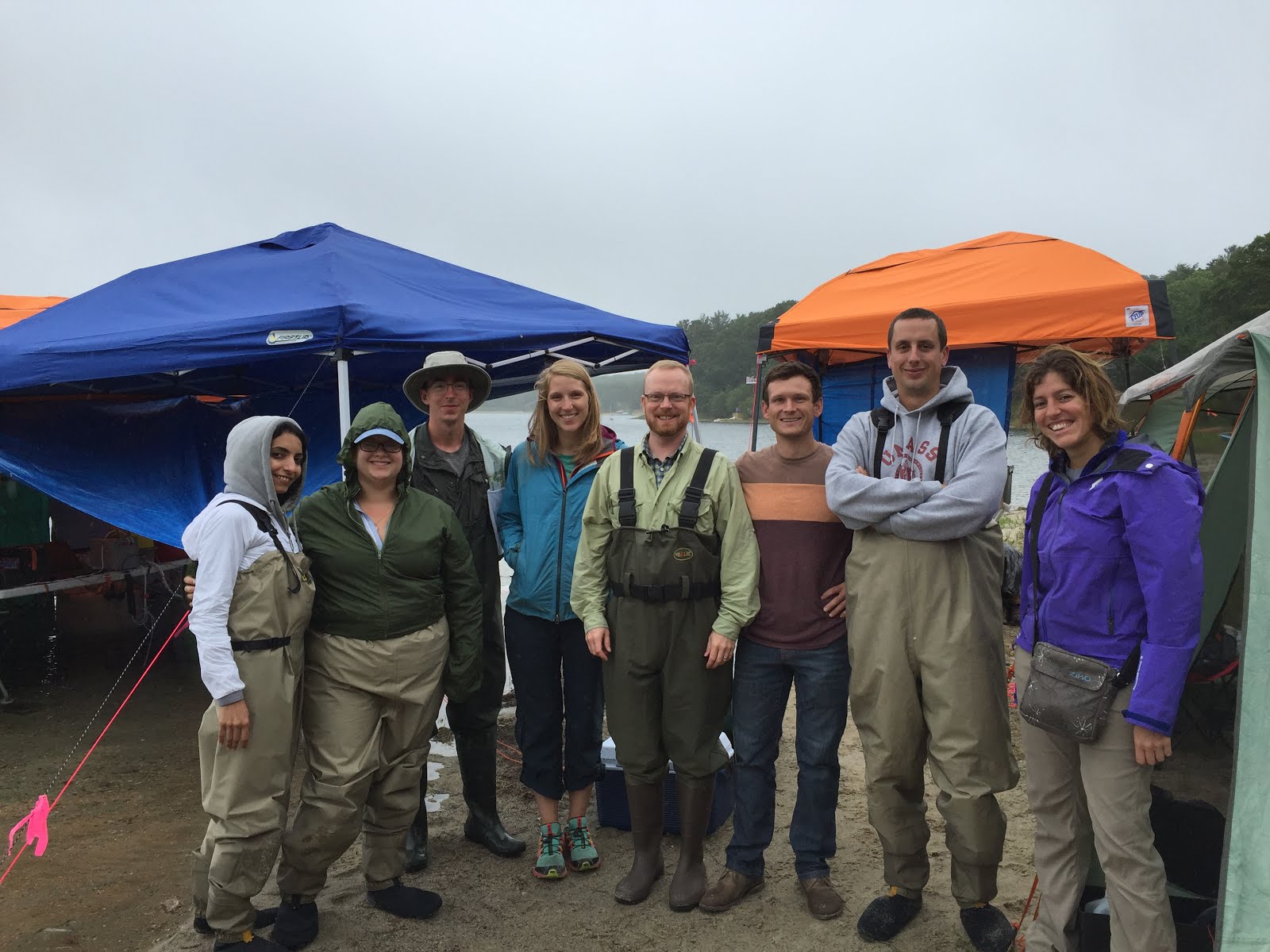
| A rainy day on Cape Cod, from left to right: Farzaneh MahmoodPoor Dehkordy (UConn), Courtney Scruggs (UConn), Tyler Hampton, Erin Seybold (Duke), Jay Zarnetske, Martin Briggs, Kamini Singha |
Field work Summer 2016 took place in a groundwater flow through lake on Cape Cod, MA, and piloted the controlled biogeochemical and hydrologic modifications, as well as the geophysical methods.
Field work during Summer 2017 took place in the Ipswich River watershed in MA, adjacent to the Plum Island LTER.
![]() |
| Michigan State Students Sinchan Roy Chowdhury and Tyler Hampton at Sawmill Brook. |
Project: Exploring the effect of carbon and DOM quality on SWI nitrogen cycling
Exploring changes in carbon reactivity and composition, and the effect on the fate of nitrate, at a stream sediment-water interface
This work was conducted to explore how dissolved organic carbon (DOC) derived from different organic matter sources degraded within the sediment water interface (SWI), and how its reactivity or 'lability' affected nitrogen cycling and denitrification products within the SWI. Field work consisted of push-pull experiments at Augusta Creek, in Hickory Corners, MI, and additional laboratory studies were conducted by Joe-Lee Cullin and undergraduate Rachel Geiger at Michigan State. This work was supported by a Kellogg Biological Station LTER Summer Research Fellowship and a GSA Summer Research Grant, as well as the NSF Research Experiences for Undergraduates Program.
![]() |
| Joe Lee-Cullin and Tyler Hampton sampling during Push-Pull experiments in Augusta Creek, Summer 2017 |
![]() |
| Joe Lee-Cullin and Rachel Geiger collecting flocculated organic matter from Augusta Creek for use in batch reactor studies of DOM quality and reactivity |
Society for Freshwater Science Annual Meeting
I had a blast at my first professional society meeting: the Society for Freshwater Science annual meeting, in Raleigh NC! The society took a strong stance for improving the environment to foster a more inclusive and diverse membership, allowing us to work together to preserve freshwater diversity. The Michigan student membership made a big step up to help organize events for the meeting next year in Detroit, and to engage the student membership in the intervening year. I also got to pinch-hit a very successful talk, and present my first year's Masters research at the poster session. Meeting so many role models and hearing so much awesome science has me riding high into the summer field season!
![]() |
| Stephen Plont and I both attended the society Endowment Reception to accept awards |
![]() |
| The MSU Green and White made a strong showing at this year's poster session! |
![]() |
| 1,000 scientist mingle session! |
Zarnetske Lab members present at MSU Fate of the Earth Conference
Zarnetske Lab members Joe and Tyler presented posters at the MSU Fate of the Earth Conference, put on by the Environmental Science and Policy Program. Tyler presents on research from the 2016 summer field season at Snake Pond on Cape Cod, MA. Next stop for this research is the Society for Freshwater Science annual meeting in June!
6 students from @MSU_NatSci Earth and Environmental Science presented posters at @ESPP #FOE2017 #IHeartNatSci pic.twitter.com/skjXU1OqGE— Tyler Hampton (@tylerbhampton) April 12, 2017
Presenting on the fate of C and N at the lake-GW interface at #FOE17 @ESPP Denitrification, ecosystem service or source of greenhouse gas?— Tyler Hampton (@tylerbhampton) April 12, 2017
Zarnetske Lab does outreach at MSU SciFest
The Zarnetske lab had loads of fun at @MSUSciFest with a couple of water cycle-centric booths! #scicomm pic.twitter.com/BPpUwknCxY— Joe Lee-Cullin (@AitchTwoJoe) April 8, 2017
— Tyler Hampton (@tylerbhampton) April 8, 2017
Team Microzones travels to UConn on CUASHI travel grant
Zarnetske Lab and Microzones members Tyler and Sinchan received funding from the Consortium of Universities for the Advancement of Hydrologic Science to travel to collaborators at the University of Connecticut and USGS Geophysics Branch. They met with Microzones team members Dr. Martin Briggs and Dr. Fred Day-Lewis and students to train on traditional Darcy columns instrumented with electrical-resistivity probes (developed by project member Dr. Kamini Singha) to quantify bulk sediment properties.
Subscribe to:
Comments (Atom)


